
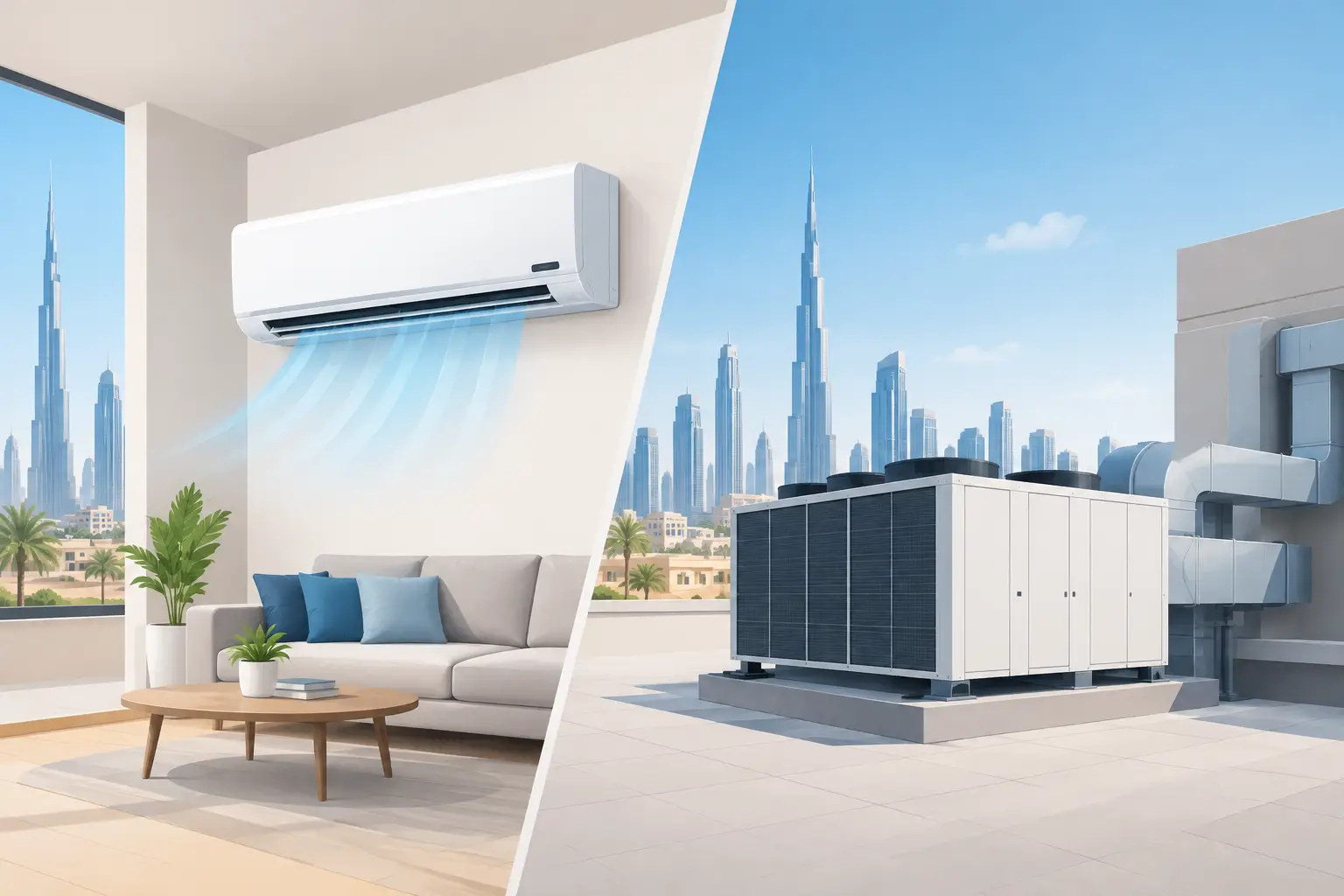
A bedroom that never cools down, an office with uneven temperatures, or an AC bill that rises without warning can turn a Dubai property into a daily source of stress. Choosing between split AC versus central AC is not simply a question of which system is more powerful. The right answer depends on your property layout, existing infrastructure, occupancy, maintenance needs, and how much control you want over each room.
For villas, apartments, offices, and managed properties, cooling is a core asset that needs dependable care. A system that is correctly sized, clean, and regularly serviced will usually deliver better comfort than a more expensive system that has been poorly maintained.
What Is the Difference Between Split AC and Central AC?
A split AC system cools a single room or defined area. It has an indoor unit, usually mounted on a wall or concealed in a ceiling, and an outdoor condenser unit. Multiple split units can be installed across a property, with each unit controlled separately.
Central AC supplies cooled air through a network of ducts to several rooms. Depending on the building, the system may use a direct-expansion outdoor unit, a packaged unit, chilled water fan coil units, or a district cooling connection. The equipment is designed to cool a wider area from a central source, often using thermostats or zoning controls.
In Dubai, the label “central AC” can mean different things from one property to another. An apartment may be connected to district cooling, while a villa may have ducted units serving separate zones. Before comparing running costs or planning repairs, a technician should identify the actual system installed and who is responsible for which parts of it.
Split AC Versus Central AC for Everyday Comfort
Split AC units are often the stronger option when room-by-room control matters most. A family can cool occupied bedrooms at night while leaving unused rooms off. In a small office, a split system can also be practical when one meeting room gets warm during busy hours but other spaces do not need additional cooling.
That flexibility can reduce unnecessary operation, but it comes with a trade-off. Each indoor unit has its own filters, coil, drain line, electronics, and refrigerant connections. A property with six or eight split units has several separate systems to inspect and maintain. If service is skipped, one room may be comfortable while another develops weak airflow, a water leak, or unpleasant odors.
Central AC tends to provide a more consistent appearance and can cool larger open areas effectively. There are no wall-mounted units in every room, and well-designed ductwork distributes air without taking up visible wall space. This suits many villas, offices, and premium apartments where clean interiors and whole-property cooling are priorities.
However, central AC is only as comfortable as its design and condition. Leaky ducts, blocked filters, poorly balanced air outlets, damaged insulation, and incorrect thermostat locations can leave rooms warmer than others. A central system may be capable of cooling the full property, yet still fail to deliver comfort evenly without proper testing and adjustment.
The layout matters more than the label
A compact apartment with closed bedrooms may benefit from separate split units. A large, open-plan villa with established ducts may be better served by central cooling. Properties with major sun exposure, double-height living spaces, glass-heavy rooms, or frequently occupied kitchens may need additional capacity or adjusted airflow regardless of the system type.
For landlords and property managers, existing infrastructure should carry real weight in the decision. Replacing a functioning central system with multiple splits can require visible piping, electrical upgrades, drainage changes, and approvals. Installing central cooling where no ductwork exists can mean ceilings, access panels, and considerable renovation work. The most economical choice is not always the lowest equipment price.
Energy Use and Monthly Cost Considerations
Neither split nor central AC is automatically cheaper to run. Energy use is driven by cooling load, equipment efficiency, thermostat settings, hours of operation, insulation, maintenance quality, and the way occupants use the property.
Split units can save energy when they allow people to cool only the rooms in use. In a villa where bedrooms are occupied mainly at night, individual controls can prevent the entire home from running at full capacity. Modern inverter split units can also adjust their output rather than repeatedly switching on and off at maximum load.
Central AC can be cost-effective when a large area needs cooling for long periods. It may be more efficient than operating many separate units at once, especially when the system is properly sized and the ductwork is sealed and insulated. In commercial spaces, a central approach can also make scheduling and temperature management easier.
Dubai residents should also consider the building’s billing arrangement. With district cooling, the cost structure may include consumption charges and fixed fees that differ from a standard electricity bill. Tenants should review their lease and provider terms before assuming that changing a thermostat or adding a room unit will change their overall cooling cost in the same way it would in a standalone villa.
Maintenance Needs That Protect Cooling Performance
Both systems need regular preventive maintenance. Dust accumulation is common in Dubai, and a clogged filter forces equipment to work harder while reducing airflow. Dirty evaporator coils, outdoor condenser coils, blocked drain lines, and refrigerant issues can all affect cooling performance and indoor air quality.
For split ACs, service should include cleaning or replacing filters, checking the indoor coil and blower, clearing the condensate drain, inspecting electrical connections, and evaluating refrigerant performance where needed. Water dripping from a wall-mounted unit is often a drain or cleanliness issue, but it should be addressed quickly to prevent damage to walls, ceilings, or furniture.
For central AC, maintenance extends beyond the main unit. Technicians should inspect filters, coils, drain pans, thermostats, blower components, duct insulation, supply and return airflow, and accessible duct condition. Duct cleaning may be appropriate when dust buildup, mold concerns, post-renovation debris, or persistent odors affect the system. It is not a substitute for repairing a failing unit, but it can support cleaner airflow when completed as part of a proper maintenance plan.
Central systems can be easier to manage under a scheduled maintenance agreement because key equipment is handled in one coordinated visit. Split systems can be equally dependable, but every indoor and outdoor unit must be included in the service scope. Skipping the units that appear to be working well often creates avoidable breakdowns during the hottest months.
When a Split System Is the Better Choice
A split AC arrangement is usually worth considering when your property has limited ductwork, you need independent control in separate rooms, or you are adding cooling to an extension, server room, guard room, or converted space. It can also be a sensible solution when only one area has a persistent comfort problem and the rest of the property cools properly.
Split systems are not always the best fit for a large property with many rooms. Numerous outdoor condensers can affect exterior appearance, create noise concerns, require more service access, and add electrical demand. The installation also needs correctly routed piping and drainage. A quick installation that ignores these details can create recurring leaks and performance issues.
When Central AC Is the Better Choice
Central AC is generally a strong fit for larger villas, established offices, and properties that already have sound ductwork and appropriate equipment space. It provides a cleaner visual finish and can deliver reliable whole-property cooling when zones are balanced correctly.
Choose central cooling carefully when flexibility is limited. If one thermostat controls a large area with different sun exposure and occupancy patterns, some rooms may receive more cooling than they need while others remain warm. Zoning controls, dampers, and properly located thermostats can improve this, but they should be assessed by a qualified technician rather than added as a guesswork solution.
For properties in communities such as Dubai Hills Estate, Arabian Ranches, Palm Jumeirah, Jumeirah Village Circle, and Dubai Marina, the best approach often depends on the property handover design and any community or building requirements. A site assessment can clarify whether upgrades are feasible before money is spent on equipment that may not suit the space.
Make the Decision Based on Your Property, Not a General Rule
Start with the condition of what you already have. A central system with clean ducts, sound insulation, balanced airflow, and regularly serviced equipment may be the sensible long-term choice. A poorly designed or severely deteriorated system may justify a targeted change, but replacement should follow a proper inspection rather than a single uncomfortable room.
Also consider who uses the property and when. A family that occupies different rooms at different times may value split AC control. An office that operates across open areas for a fixed schedule may benefit from centralized cooling. Landlords should think about durability, tenant expectations, service accessibility, and the cost of maintaining the system between tenancies.
WeMaintain Technical Services LLC can assess cooling performance, identify faults, complete AC servicing, and help homeowners or businesses plan practical repairs or upgrades without coordinating multiple contractors. The goal is not to push one system over another. It is to keep your home or office comfortable, efficient, and ready for Dubai’s heat.
If your AC is struggling, begin with an inspection before deciding on replacement. A clean system, clear airflow path, accurate thermostat, and timely repair can make the difference between another difficult summer and a property that stays comfortable when it matters most.
Leave a Reply